Creating through the art of patience in porcelain, I have discovered that portraiture is, perhaps, the most profound challenge for an artist: it is the art of seeing beyond the surface to capture the soul.
The Mastery of Oil Painting in Mole and the Power of Observation
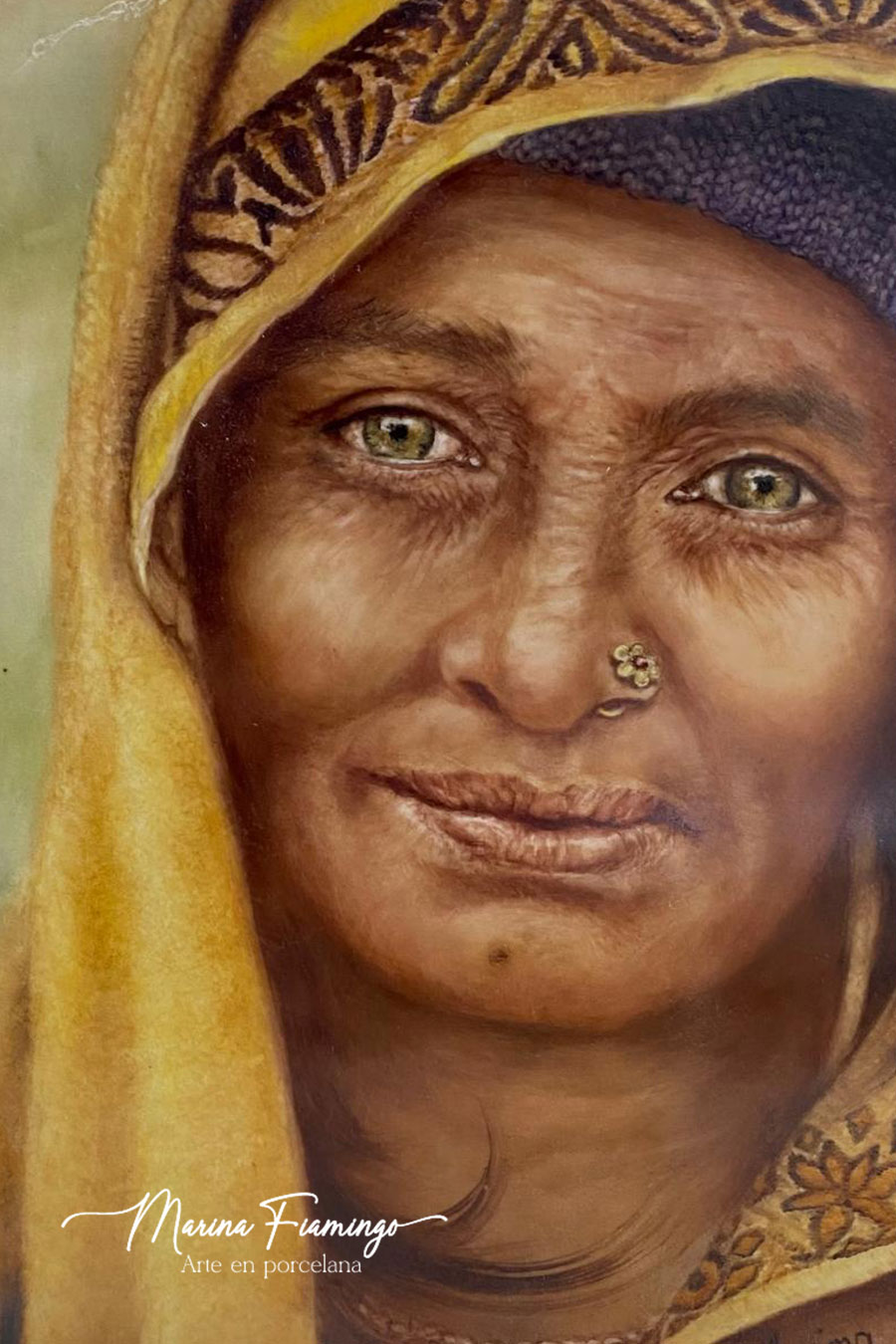
This “Portrait of a Woman” is not merely a technical piece, but the result of an intensive study process where observation became my primary tool. In the studio, every glance and every shadow reminded me that, to paint life on porcelain, we must first learn to honor the details that make us human, transforming pigment into pure emotion.
The Privilege of Continuing Education
This work was born in a very special context: an intensive seminar with Professor Monica Conde, ...an artist I deeply admire. Studying with her allowed me to delve deeper into the technique of oil in mole, taking my observational skills to a new level of rigor. As we already explored in my analysis of the oil painting in black and white, Realism is not about copying an image, but about interpreting light, and under Monica's guidance, that interpretation became much sharper and more precise.
The Technique of Portraiture: A Challenge of Precision
Painting a face freehand on porcelain requires almost meditative discipline. The use of the oil in mole (Open oil) in this piece was key to achieving the smooth transitions of the skin and the depth of the gaze. Unlike what happens in works of greater contrast such The Force of Nature, Here, the challenge was subtlety. The goal was for the softness of the brushstrokes to allow the viewer to feel the warmth of the face, as if the porcelain had ceased to be a cold material and had become skin.
The Power of Observation in Oil Painting in Mole
Portraiture forces us to confront our own patience. During the seminar, we dedicated hours to understanding how light travels across the contours of the face before the brush even touched the piece. Thanks to the nobility of the oil in mole, I was able to work on and correct each feature, ensuring the anatomy was perfect before the first firing. This technique allows for unique creative freedom, enabling me to "sculpt" with the brush until the woman's expression in the porcelain was just right.
The Importance of Mentoring in Art
Admiring other artists and learning from their methods is what keeps the flame of creativity alive. My time in the studio of Monica Conde It reinforced my belief that porcelain art is an endless path of learning. By sharing this work with you, I'm not just sharing a finished piece, but a piece of my own growth as a guide and artist. oil in mole It is the language I chose for this journey, and each portrait is a new opportunity to perfect the dialect of beauty and technique.
FAQs about Oil Portraits in Mole
Find here the answers to the usual questions I receive about the Oil on Mole Technique and its use in portrait works.
Why is porcelain portraiture considered a difficult technique?
Porcelain portraiture is a complex technique because it demands absolute anatomical precision and total control of light. When working with oil in mole, The artist must be able to foresee how the shadows and features will be fixed after firing, since the human face is the structure that most easily reveals any errors in proportion.
How does oil painting on a thick surface help achieve realism in faces?
He oil in mole It helps achieve realism because it allows for much longer mixing times than other techniques. This facilitates the creation of imperceptible gradients and soft glazes, which are essential for replicating skin texture and the softness of features without leaving obvious brushstrokes.
Is it necessary to know how to draw freehand to paint portraits?
Knowing how to draw freehand is a fundamental basis for achieving the mastery I aim for in my work. In the oil in mole, Direct observation and the ability to map the face on the porcelain without templates is what differentiates a handcrafted piece from a work of art with soul and technical depth.
What role does an intensive seminar play in the training of an artist?
An intensive seminar allows the artist to step outside their comfort zone and subject their technique to the scrutiny of an expert mentor. In my experience, studying with artists like Mónica Conde accelerates mastery of the oil in mole, forcing us to refine our clinical eye and discover new ways to solve volume and color challenges.
Display currency was reset to the store default because the selected currency would show amounts as zero. Please update the exchange rate and Number of Decimals in Multi Currency settings.