
If we address the basis of human realism, we must know that you cannot build a palace on sand; realism in porcelain begins with an impeccable structure that supports the beauty of each feature.

Author and creator.
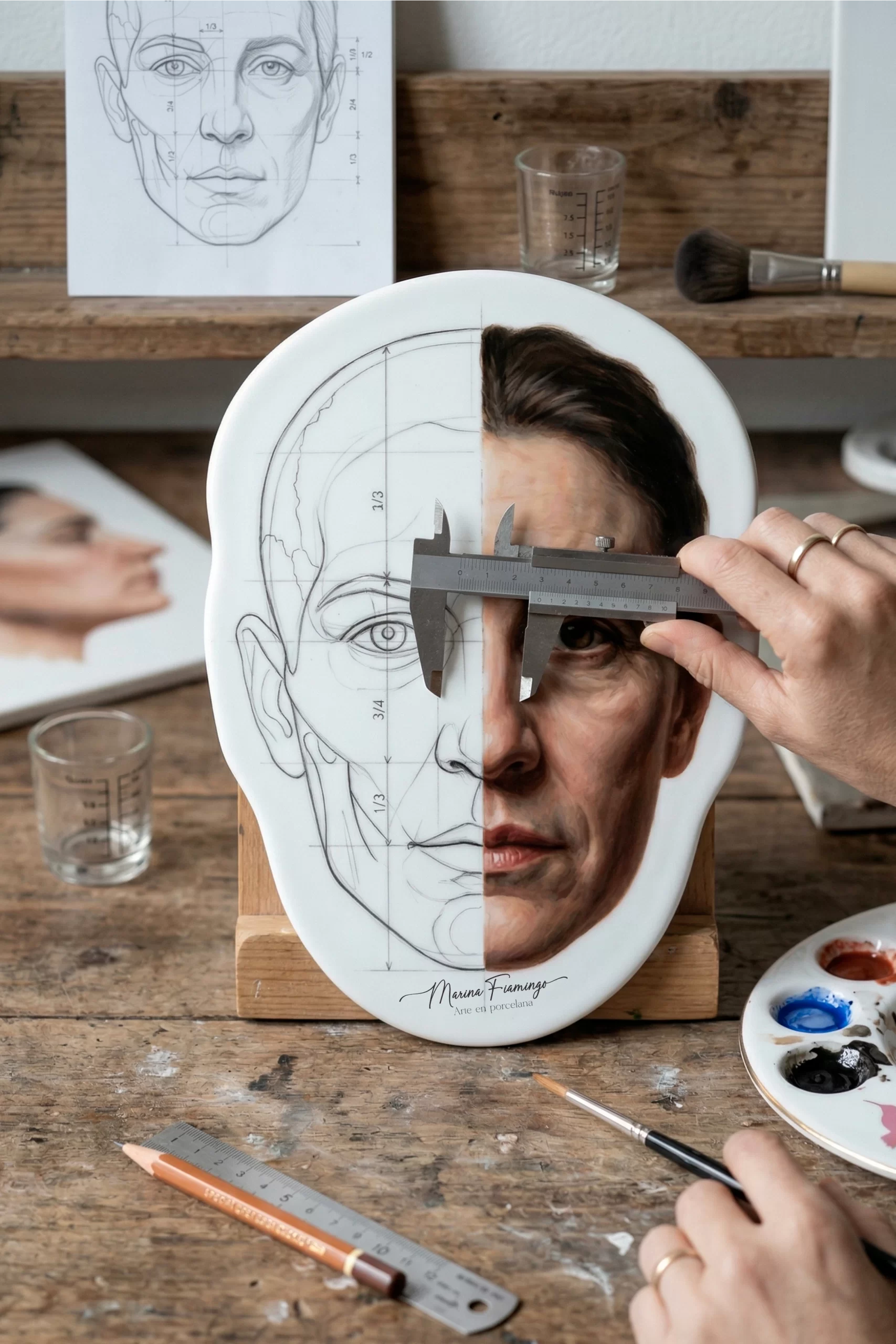
In portraiture, drawing is the law and proportion is its language. Before even thinking about the skin tones Or in the sparkle of the eyes, we must ensure that every feature is where nature intended. An eye a millimeter higher or a slightly askew nose shatters the illusion of realism and, worse, the subject's identity. At the Atelier, we understand that anatomy is not a limitation, but the foundation that allows us freedom with the brush, guaranteeing that our work has the necessary solidity to be called a masterpiece. To paint a face, we must first learn to measure it. There are rules of proportion—such as dividing the face into thirds or the distance between the inner and outer corners of an eye—that are universal. However, in the freehand painting, The challenge lies in adapting that canon to the curved or flat surface of the porcelain slab. This "fitting" stage is where patience becomes technique: we are not seeking cold, mathematical perfection, but an organic structure that respects the actual anatomy and serves as a map for the layers of color that will follow.
Although we seek harmony, pure realism thrives on the small asymmetries that make us unique. No one has two sides of their face exactly alike. The key to mastery in portraiture It lies in observing those subtle differences: a higher eyebrow, a deeper lip commissure, or a shadow that defines the cheekbone differently. Capturing these anatomical variations is what allows the viewer to recognize not just a "face," but a specific person with their history and character imprinted on the porcelain.
A full-face portrait is challenging, but a profile or foreshortening requires absolute mastery of perspective. When painting on porcelain, we must be aware of how the shape of the piece (a bowl, a jug, or a flat plate) can visually distort the anatomy. Training the eye to compensate for these distortions is part of the discipline of observation daily. The bone structure must be felt beneath the paint; we must "feel" the skull and jaw so that the volumes of light and shadow have coherence and do not appear as floating blobs.
The process of transferring anatomy to porcelain must be clean and precise. We often use special grease pencils that disappear in the kiln to mark reference points. This guide gives us the confidence to apply the first pigments decisively. When working with oil in mole, The anatomical structure becomes our anchor: if the base is solid, we can play with the density of the material to create reliefs in the cheekbones or the nasal septum, raising the realism to an almost tactile dimension that will be vitrified forever.
At the end of the process, when the anatomy is correct, the technique becomes invisible, and what emerges is emotion. A well-structured portrait is one where the measurements are not visible, but rather the expression. It is the result of uniting the rigor of drawing with the artist's sensitivity. I invite you to embrace the study of forms and proportions as a path to freedom; once you master the foundations, there will be no face or gaze that your brush cannot capture with the fidelity and elegance that only handcrafted porcelain allows.
Find here the answers to the most frequently asked questions I receive about this publication.
If the error is minor, it can be corrected by strategically using light and shadow in subsequent layers to "trick" the eye. However, if the error is structural (such as a misplaced eye), porcelain painting offers the possibility of carefully removing the area before the next firing or using covering techniques, although ideally the necessary time should be dedicated to the initial fit to avoid complex rework.
You don't need to be an accomplished artist, but it is vital to develop observation skills and understand the basic rules of proportion. In Marina Fiamingo's workshop, we provide tools and transfer methods that help students position features correctly, allowing them to focus on color and volume techniques without the frustration of a failed drawing.
Generally, the nose and ears present the greatest challenge due to their volumetric complexity and their location in relation to other features. The nose acts as the central axis of the face; if its angle or size is incorrect, it throws the entire portrait off balance. That's why we pay special attention to its placement, ensuring that its base and bridge respect the perspective of the face.
Anatomy dictates where the deepest shadows should fall (areas of depression such as the eye sockets or under the jaw) and where the points of light should fall (areas of bone such as the forehead or cheekbone). Understanding bone structure allows the artist to place the pigment with technical intention, creating the necessary volume for the portrait to go from being a flat image to a three-dimensional representation that seems to come out of the plate.
Join our Virtual Atelier and receive monthly reflections on the art of patience and exclusive oil painting techniques on mole.