Creating through the art of patience in porcelain, I have come to understand that capturing a child's gaze requires a very particular technical sensitivity.
Childhood Portrait: The Softness of Open Oil on Porcelain
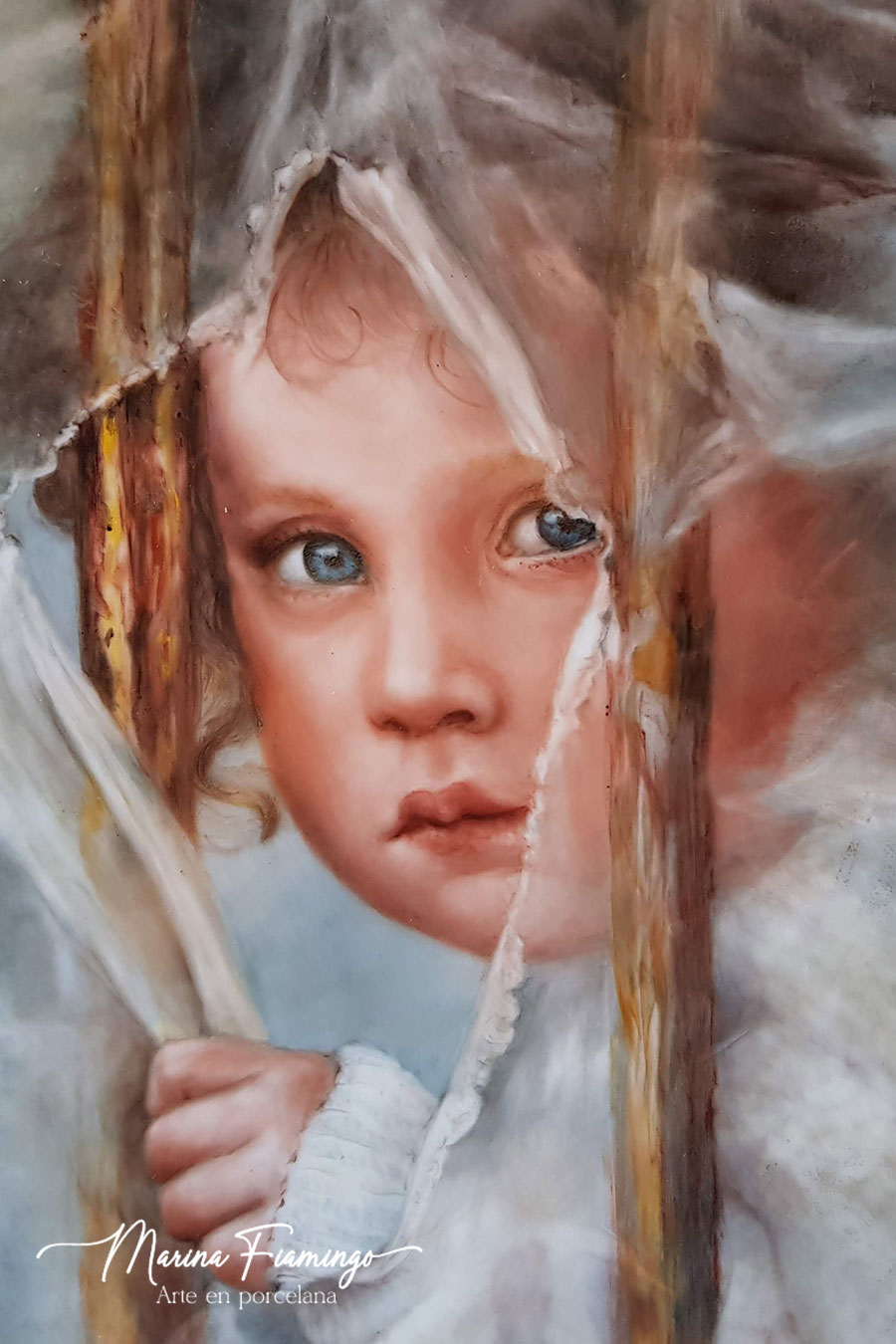
In this portrait, painted on a porcelain plaque in 2015, the challenge lay not only in the anatomical proportions but also in capturing the ethereal and gentle atmosphere of childhood. Through the child's crystalline gaze, I sought to convey curiosity and purity, allowing the porcelain to transcend its rigid surface and become a breath of light and color.
The Open Oil Technique on Faces
Unlike other works where the precision of oil in mole That's the key, in this intensive seminar with the professor Monica Conde we opted for the use of open oil. This technical variation is fascinating because it gives the artist extended working time, allowing them to blend the colors with extreme delicacy before firing. As we already mentioned in my article on the mastery of portraiture, The choice of vehicle (the oil) determines the final texture of the skin on the porcelain.
A Two-Burning Process: Layers of Emotion
Achieving this depth in just two firings was an exercise in synthesis and confidence in the brushstroke. During the first intensive day, we focused on the tonal map and the main volumes; on the second, we dedicated ourselves to the details that bring it to life, such as the sparkle in the eyes and the softness of the hair that seems to peek out from behind a veil. This piece taught me that the porcelain painting It is a constant dialogue between the intention of the brush and the response of the fire, where each burn consolidates a layer of the story we want to tell.
The Influence of Mentoring on Realism
Again, the guidance of a teacher like Monica Conde It was the catalyst for achieving this level of realism. In art, surrounding oneself with role models who master the open oil technique is what allows for leaps in quality in the handling of soft shadows. This portrait is the testament to two days of total immersion, where the objective was to capture not just an image, but the feeling of a presence. It is a reminder that, in the freehand painting, The soul of the artist is transferred to the piece through observation and shared technique.
The Gaze as Narrative Center
In this portrait, the composition plays with what is seen and what is suggested. The brushstrokes that frame the child's face, applied with the fluidity afforded by open oil paint, create an organic frame that directs all attention to those blue eyes full of questions. For me, this work represents the search for perfection in subtlety, demonstrating that in the hand-painted porcelain, Sometimes what is suggested is as powerful as what is precisely defined.
FAQs about Open Oil Portraiture
Find here the answers to the frequently asked questions I receive about the Open Oil Technique.
Open oil is a vehicle that keeps pigments fresh and workable for much longer than closed oil. Its use is ideal for portraits and pieces that require very delicate blending and smooth color transitions, as it allows the artist to go back over the painting and correct gradients before firing.
How is it possible to paint a realistic portrait in just two firings?
Painting a portrait in two firings requires rigorous technical planning and mastery of tonal value from the first brushstroke. The first burn establishes the base shadows and main structures, while the second applies the high-definition details and final color adjustments that bring the expression to life.
What is the difference between open oil and closed oil?
The main difference lies in the drying time and the viscosity of the material. While the oil closed It tends to set faster, allowing for almost immediate precision work; open oil offers prolonged manageability, making it the preferred choice for achieving smooth skin in children's portraits or atmospheric backgrounds.
Why is a porcelain plaque used for portraits?
The porcelain plate offers a flat and stable surface that facilitates the composition and visualization of anatomical proportions. Unlike curved objects, the plate allows the artist to work with the same logic as a traditional canvas, but taking advantage of the unique luminosity and durability that only vitreous china can offer.
Display currency was reset to the store default because the selected currency would show amounts as zero. Please update the exchange rate and Number of Decimals in Multi Currency settings.